Showing posts with label Guided Questions. Show all posts

Tuesday, March 16, 2021

Guided questions, week 9 (Question 2)

Entry 45

Reflection

Topic: How do we change our messages and means of communication for a public audience?

Our message and communication changes depending on the type of audience that we receive. When getting a live audience we may try to simplify our message, more to the point and we will probably try to provide more physical data. We will also be able to connect more with a live audience, we can see their opinion and communicate openly with them on our topic. We can ask them questions and their side and maybe start a discussion and then present the message and data collected. Messages and ways to communicate change depending on what our goal is with our audience and how we see the audience. Also, each writer or speaker may have a different approach. There are so many ways to connect with our audience in person, a connection that cannot be built as well on paper. 

Monday, March 15, 2021

Guided Questions Week 10 (Part 1)

Entry 44:

Reflection

Topic: How does the presenting/sharing of our research change across audiences and contexts?

How we change our presentation depends on how we are reaching our audience. When we write a paper, we pick out our target audience and figure out how we would like to inform them. However, if you are changing how you give out your information on your topic like to speak it aloud to an audience you would be giving an entire different presentation than what your paper would say or look like. Your paper is more factual and wordy, an in person presentation would maybe require some pictures, video explanations, maybe inviting people to speak up with data- but this all depends on what context you are trying to present your topic. 

Sunday, March 7, 2021

Guided Questions, Week 9 (Question 1)

 Entry 39:

Reflection

Topic: What are the benefits and limitations of the specific methods you selected in order to research your question(s)?

    Personally, problems that I encountered while conducting my primary research was figuring out how to get out my survey to a variety of age groups, I figured social media would be the easiest way to just send it out- it was. Although, I wish I could have gotten a few surveys from people outside of my papers focus group, so that I would have more data. While I think social media helped me to get my survey out quickly, I think that maybe I could have used several of my accounts for the variety I was looking for. So, it created a limitation of having less data and probably created a bit of bias. Limitations from my secondary research would be there are not a lot of articles on my topic and also I had to learn how to use different databases, just more help for future projects in my life though!
    Benefits however included an easier way for my friends to share it with their friends and family. I also got data from my age group of study. The other methods of research was using different databases, there were a lot of benefits from that. I got data from several years ago (within the seven year time frame) and I got to see so many different views on my topic and could take a lot of notes. 


Thursday, March 4, 2021

Guided Question Week 8, (Question Part 3)

 Entry 36:

Reflection

Topic: In what ways has working from proposal 1 to the start of project 2 been useful?

From writing the proposal to writing half of a draft for project 2 made it easier to write. The proposal gave me time to gather research and we already started building and practicing ideas and writing for project 2. I think I could have written all 10 pages easily because of the set up the proposal helped me with. I have collected so much research and I could easily interview friends and maybe a professor, or send out a survey to people within the age group I have made my focus group. Proposal 1 was basically collecting research and project 2 is the writing of the research collected- our class is all connected and it makes it easy to do the work. I could write my paper in a day, if I wanted, because the set up and ideas have been developed in other assignments and research has already been done and I just need to form it all into words now. Working from that to starting project 2 has been insanely easy and I appreciate the set up of the class to help me with my research paper, I have never felt so confident in my writing!

Monday, February 15, 2021

Guided Question (Week 6, Question 2)

 Entry 24: 

Research

Topic: How does a thesis work?

    As we work on project 2, we need to find our argument, create a thesis to build our paper around. In order to understand how a thesis works, we need to know what a thesis statement is. A thesis is a statement or theory that is put forward as a premise to be maintained or proved. 
A thesis works by clearly identifying the topic being discussed, the thesis statement belongs in the first paragraph (introductory paragraph). 
    It is important to note that a thesis statement does not state a facts, but rather an opinion for you to prove. It always takes a stand to be justified later. 
Image result for thesis statement

    A thesis works when you can present a topic and be able to debate it. If you cannot take a stand, you will struggle to answer questions and debate- therefore you have no thesis. 

Thursday, February 11, 2021

Guided Question (Week 5, Question 2)

 Entry 21:

Reflection:

Topic: What kinds of writing, collecting, and annotating do we need to do while we are conducting research?

    While writing you should always annotate your sources, take notes on your sources and make sure they fit what you are writing about. Try to incorporate some into your writing to make sure that your source and what you are saying in your writing make sense, if your research goes against what you are saying, it is probably not the resource for you and you should continue with conducting research. It is important to try and have ideas of what you need to find before going into your research. I found tips that said that writing summaries about your research can help you write your paper more fluently. 
    While conducting research it is important to do all these things to make the best paper possible. You should be able to talk about what you just read to make sure that the ideas stuck. I gave tips in another blog talking about how to do these things if you would like to check out my others! 

Tuesday, February 9, 2021

Guided Question (Week 5, Question 1; Part 2)

 Entry 20:

Reflection

Topic: Why do we need to know how to access, read, analyze, evaluate, and use secondary resources in our own research writing and everyday lives?

    Knowing how to research anything, especially in society today, is crucial. How often people go to the internet for solutions to any type of problem is almost daily. I know that my search history is long in just dumb questions that I had mid-conversation or for school, or something I needed to figure out for my house. 
    For those who do not know where to go for secondary resources, you can refer to entry 19 or I can tell you here. Secondary resources can be found in books, journals or online. I think in society today, most of us choose the internet- which there is no problem with that at all- because it is always within reach via phone, computer, tablet and so on. 
    So now we know how to access it, reading it should be fairly simple as long as you know exactly what you are looking for. I would say evaluating its usefulness would be easy given that you would know if it helped you or not when you tried to use it, and if it did not help you within your writing or life, it is a lot easier to find than primary research! 


Monday, February 8, 2021

Guided Question (Week 5, Question 1; Part 1)

 Entry 19:

Research + Reflection + Multimodal

Topic: What is secondary research? 

    According to my research and things that we have already discussed in class. Secondary research is: a research method that uses existing data. Documents that contain secondary research can be found in a variety of places like public libraries, websites, or data obtained from filled in surveys and so much more. The article I found talking about secondary research said that secondary research is more cost-effective than primary research. 
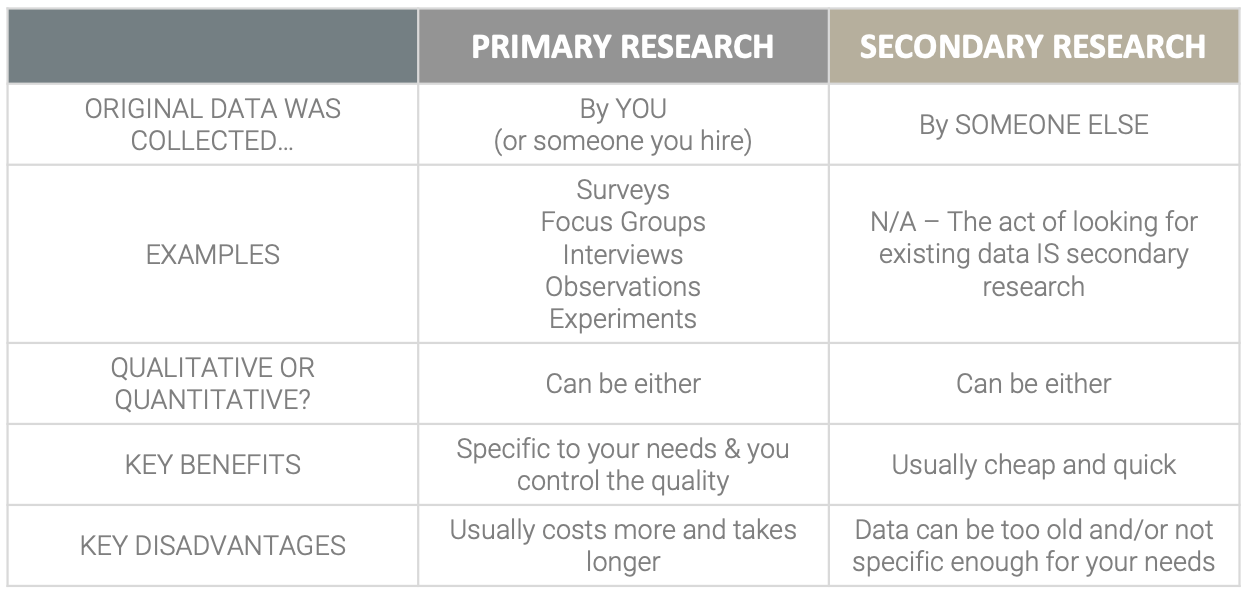
    In this picture it explains the difference between primary and secondary research in a chart like format: 
Summary of Primary vs. Secondary Market Research
Ironically, looking at this chart, I think I for a while misunderstood the research methods and flipped them around. 
    In the link that I used it gives more in depth examples if you would like to use it: questionpro 
Reflection:
    Knowing how to find this secondary research may take a while because you need to find exactly what suits your topic, but it will most likely not take as long to find as primary would. However, primary research would help you find exactly what you are looking for. I think that it is beneficial to have both, however you can probably find a survey and all of those things without having to do too much work.

Wednesday, January 27, 2021

Guided Questions (Week 3)

 Entry 9:

Research

Topic: "What counts as inquiry for academic research?"

    Inquiry requires scholars to actively engage in what they are learning by generating questions that drive them to conduct answers and explore problems. While research addresses the process of finding answers. Academic research writing is a form of research writing. It is different however because of it having a thesis, evidence, and citation.     
    So in order for inquiry to count for academic research, there needs to be an active engagement in the research being conducted. Thinking of further questions, looking into other options, and so on. 

Saturday, January 23, 2021

Guided Questions (Week Two)

Entry 6:

Research/Connections

Topic: How is reflection beneficial to learning?

    Reflective learning has readers step back and really try to understand exactly what they just read. Readers can connect what they just read to their own personal experiences. Reflection also helps build a readers critical thinking skills. It encourages learners to engage more in their readings and take charge of their own learning. 
    I have used concepts from other classes in order to help me understand topics in my everyday life. You can notice a lot of similar concepts throughout different classes if you reflect on your reading and actively try to comprehend your readings. 
    Connecting ideas between classes or personal experiences helps to put things into perspective. Trying to compare ideas between your life and something going on in class or a situation a friend is facing maybe could be explained by a reading you have done. Attention and reflection is a big part of life and does not always need to be based on readings. Reflecting and connecting during and after your reading benefits you in writing. 

Friday, January 22, 2021

Guided Questions Answered (Week One)


 Entry 3:

Multimodal 

Topic: Brainstorming strategies 


Types of Brainstorming - Brainstorming- instructional strategy

 1. Freewriting:

  • Let your thoughts flow out on a piece of paper or on your computer screen and just write. Set a limit for however long you feel is good (10-20 minutes or until you reach a certain page amount) and just go for it. When the time is up, read over it. Pick things that you like and then go with that and start your research.  

2. Looping:
  • Similar to the freewrite method but going a little bit farther. Move in groups and write for 5-10 minutes. Move onto another piece and do the same things a couple more times. Analyze what you have done and then develop what you found using this method. 
3. Listing:
  • Start jotting down ideas, write a sentence for each and then group together similar ideas and/or pick your favorite idea from the list. 
4. Idea mapping:
  • Write the subject in the center of a page and then work out the details around the idea.
5. Researching:
  • Just start browsing ideas until one really sticks out and then continue exploring the idea. 
6. Ask questions:
  • "What if”, “pros and cons”, so on. 


Finals thoughts

 Entry 67: Topic: Thoughts     I am slowly but surely, running out of things to talk about in my blog. As time has been progressing I keep f...